Digital Marketing Metrics That Actually Matter for Business Growth
Digital marketing metrics help businesses understand whether their marketing activities are generating real business results. While impressions, clicks and website traffic can provide useful information, they do not always tell you whether marketing is actually producing qualified leads, customers and revenue.
The most valuable digital marketing metrics connect marketing activity to business outcomes.
For example, 10,000 website visitors may look impressive, but if only five people become customers, the traffic may not be particularly valuable. On the other hand, 1,000 visitors generating 50 qualified leads and 15 customers could represent a much stronger marketing performance.
What Are Digital Marketing Metrics?
Digital marketing metrics are measurable data points used to evaluate the performance of online marketing activities such as SEO, Google Ads, social media, email marketing, content marketing and paid advertising.
Some common digital marketing metrics include:
- Website traffic
- Click-through rate
- Conversion rate
- Cost per lead
- Cost per qualified lead
- Customer acquisition cost
- Return on advertising spend
- Lead-to-customer conversion rate
- Revenue generated
- Customer lifetime value
The important point is that not every metric has the same business value.
A business should focus on metrics that help answer a simple question:
Is our marketing generating profitable business growth?
1. Website Traffic
Website traffic is one of the most commonly monitored digital marketing metrics.
It tells you how many people are visiting your website and where those visitors are coming from.
You can examine traffic from:
- Organic search
- Google Ads
- Social media
- Referral websites
- Direct traffic
- Email campaigns
However, traffic should not be treated as the final measure of marketing success.
For example, an increase in organic traffic is positive, but you should also determine whether those visitors are relevant to your products or services.
Better question: Are website visitors taking valuable actions?
That could include submitting a form, calling your business, booking an appointment, requesting a quotation or purchasing a product.
2. Conversion Rate
Conversion rate is one of the most important digital marketing metrics because it shows how effectively your website or campaign turns visitors into leads or customers.
The basic calculation is:
Conversion Rate = Conversions ÷ Total Visitors × 100
For example, if 1,000 people visit a landing page and 50 submit a form, the conversion rate is 5%.
Conversion rate can be measured for different actions, including:
- Form submissions
- Phone calls
- Product purchases
- Appointment bookings
- Demo requests
- Downloads
- Sign-ups
A campaign with fewer visitors can outperform a high-traffic campaign if its conversion rate is significantly higher.
3. Cost Per Lead
Cost per lead (CPL) tells you how much your business spends to generate one lead.
For example, if you spend ₹50,000 on advertising and generate 250 leads:
CPL = ₹50,000 ÷ 250 = ₹200
CPL is useful for comparing campaigns, channels and audiences.
However, a low CPL does not automatically mean better performance.
A campaign generating leads at ₹100 each may be less profitable than a campaign generating leads at ₹300 each if the ₹300 leads are much more likely to become customers.
That is why businesses should move beyond lead quantity and measure lead quality.
4. Cost Per Qualified Lead
Cost per qualified lead is often more meaningful than basic CPL.
A qualified lead has a realistic possibility of becoming a customer based on factors such as need, location, budget, product fit or purchase intent.
Suppose:
- Campaign A generates 500 leads at ₹100 each.
- Campaign B generates 100 leads at ₹300 each.
Campaign A appears cheaper.
But if Campaign A produces only 10 qualified leads while Campaign B produces 40 qualified leads, Campaign B may actually be delivering better marketing performance.
This is why digital marketing metrics should be connected to sales quality, not just lead volume.
5. Customer Acquisition Cost
Customer Acquisition Cost (CAC) measures the average cost of acquiring a new customer.
A simplified calculation is:
CAC = Total Marketing and Sales Cost ÷ Number of New Customers
If a company spends ₹2,00,000 on marketing and sales and acquires 100 new customers, its average CAC is ₹2,000.
CAC becomes particularly useful when compared with customer lifetime value.
If acquiring a customer costs ₹2,000 but that customer generates ₹10,000 in profitable revenue over time, the acquisition economics may be attractive.
6. Lead-to-Customer Conversion Rate
Generating leads is not the same as generating customers.
The lead-to-customer conversion rate shows how many leads eventually become paying customers.
For example:
- 200 leads generated
- 20 customers acquired
Lead-to-customer conversion rate = 10%
This metric can reveal problems that traffic and lead reports may hide.
If your business generates plenty of leads but very few customers, the problem may be related to:
- Lead quality
- Sales follow-up
- Pricing
- Product-market fit
- Sales process
- Landing-page expectations
- Communication speed
Marketing and sales data should therefore be evaluated together.
7. Return on Ad Spend
Return on Ad Spend (ROAS) measures the revenue generated in relation to advertising expenditure.
For example, if you spend ₹50,000 on Google Ads and generate ₹2,00,000 in attributed revenue:
ROAS = 4x
ROAS can help businesses compare paid campaigns and identify where advertising investment is producing stronger returns.
However, ROAS should not be viewed in isolation because revenue is not the same as profit.
A campaign can have strong ROAS but weak profitability if product margins, fulfilment costs or other expenses are high.
8. Revenue and Profit
Ultimately, business growth comes down to financial outcomes.
Marketing dashboards should eventually connect campaign performance with:
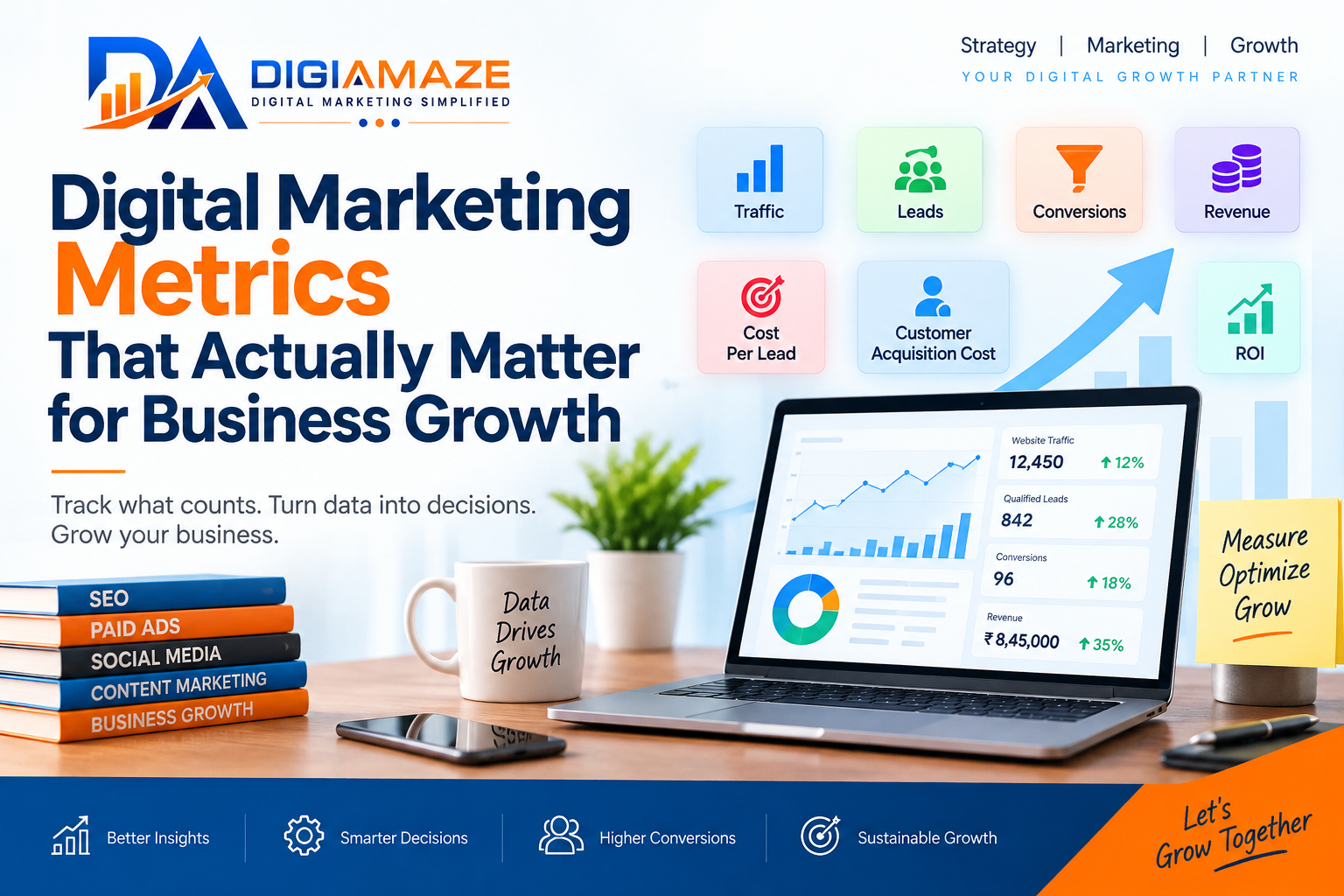
Traffic → Leads → Qualified Leads → Customers → Revenue → Profit
This is a much stronger measurement framework than focusing only on impressions, clicks or followers.
A digital marketing campaign should ideally answer:
- How many relevant people did we reach?
- How many became leads?
- How many leads were qualified?
- How many became customers?
- How much revenue was generated?
- Was the campaign profitable?
9. Customer Lifetime Value
Customer Lifetime Value (CLV or LTV) estimates the total value a customer can generate during their relationship with a business.
This is especially important for businesses with repeat purchases, subscriptions or long-term customers.
For example, acquiring a customer for ₹1,000 may look expensive initially. But if that customer generates ₹15,000 in revenue over several years, the economics can be very different.
This helps businesses make better decisions about acquisition budgets and customer retention.
Which Digital Marketing Metrics Should Businesses Track?
A practical dashboard could include:
| Marketing Area | Important Metric |
|---|---|
| SEO | Organic conversions |
| Google Ads | Cost per qualified lead |
| Social Media | Leads and conversions |
| Website | Conversion rate |
| Lead Generation | Qualified lead rate |
| Sales | Lead-to-customer rate |
| Advertising | CAC and ROAS |
| Business | Revenue and profit |
| Retention | Customer lifetime value |
The goal is not to track every available number.
The goal is to identify the smallest set of digital marketing metrics that explains business performance clearly.
How AEO and GEO Change Marketing Measurement
As search increasingly includes AI-generated experiences, businesses may also want to understand visibility across AI-powered search experiences.
However, there is no single universal “GEO score” or guaranteed formula for appearing in AI-generated answers.
Google’s current guidance specifically addresses misconceptions around “AEO/GEO” and emphasizes that established SEO fundamentals remain relevant for generative AI features.
For content intended to perform well across traditional and generative search, focus on:
- Answering questions directly
- Using clear headings
- Providing original insights
- Demonstrating real expertise
- Explaining concepts accurately
- Using relevant entities and terminology naturally
- Providing useful examples
- Keeping important information accessible in the page content
This makes content easier for both people and search systems to understand.
Frequently Asked Questions
What is the most important digital marketing metric?
For most businesses, there is no single universal metric. Revenue, qualified leads, customer acquisition cost, conversion rate and profitability are generally more useful than vanity metrics such as impressions or follower counts.
Is website traffic an important marketing metric?
Yes, but traffic should be evaluated for relevance and conversion. High traffic without leads, customers or revenue may not contribute significantly to business growth.
What is more important: leads or sales?
Sales are the ultimate business outcome, but qualified leads are an important leading indicator. Businesses should measure the complete journey from lead generation through customer conversion.
How do you measure digital marketing success?
Measure the journey from traffic → conversions → qualified leads → customers → revenue → profit. The exact metrics should depend on your business model and marketing objectives.
Final Thoughts
The best digital marketing metrics are not necessarily the numbers that look impressive in a monthly report.
They are the numbers that help you make better business decisions.
Traffic can tell you whether people are arriving. Conversion rate can show whether your website is turning visitors into leads. Qualified lead rate can reveal lead quality. Customer acquisition cost can show what it costs to win customers. Revenue and profit ultimately tell you whether the marketing is creating sustainable business growth.
Instead of asking “How much traffic did we generate?”, businesses should increasingly ask:
“How much profitable business did our marketing generate?”
That shift from activity-based reporting to outcome-based measurement can make digital marketing more accountable, efficient and valuable.
About the Author:
Kotla Ranjith Kumar Reddy is a Digital Marketing Consultant in Hyderabad, helping businesses improve SEO, paid advertising, lead generation, conversion optimization and digital growth strategies across India, USA, UK, Canada, Australia and Singapore.