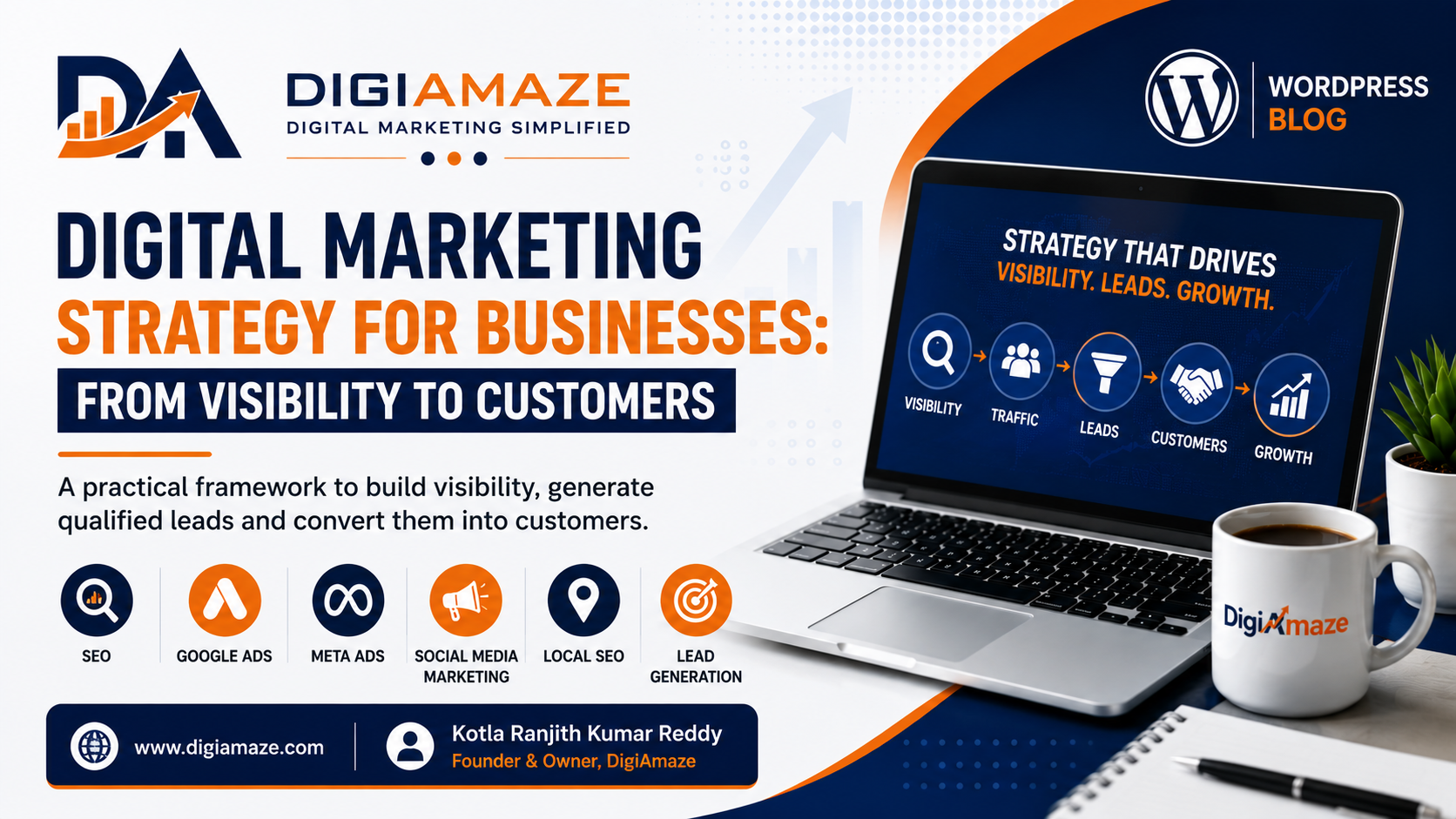
Digital Marketing Strategy for Businesses: From Visibility to Customers
A practical framework for turning online visibility into qualified leads, customers, and sustainable business growth
Digital marketing has become an essential part of how businesses attract customers, build credibility, and compete in today’s market.
But there is a major difference between doing digital marketing and building a digital marketing strategy that contributes to business growth.
A business can have thousands of website visitors, an active social media presence, good advertising reach, and hundreds of leads—and still struggle to generate consistent revenue.
The reason is simple:
Digital marketing activities are not the same as a digital marketing strategy.
A strategy connects different activities to a common business objective:
Visibility → Traffic → Engagement → Leads → Qualified Opportunities → Customers → Growth
Based on my experience working across SEO, Google Ads, Meta Ads, Local SEO, lead generation, content marketing, and performance marketing, I believe businesses should look at digital marketing as an interconnected growth system rather than a collection of individual channels.
I’m Kotla Ranjith Kumar Reddy, a Digital Marketing Consultant and Founder/Owner associated with DigiAmaze, where the focus is on helping businesses improve online visibility, generate relevant leads, and build practical digital growth strategies.
In this guide, I’ll explain the framework I use to think about digital marketing strategy—from the first search or impression to the point where a prospect becomes a customer.
1. Start With the Business Objective
One of the biggest mistakes businesses make is starting with a marketing channel.
They ask:
“Should we run Google Ads?”
“Should we do SEO?”
“Should we start Instagram?”
“Should we run Meta Ads?”
I believe the first question should be different:
What business outcome are we trying to achieve?
That could be:
- More qualified leads
- More appointments
- More phone enquiries
- More website enquiries
- More customers
- Higher sales
- Lower customer acquisition cost
- Increased local visibility
- Better brand awareness
The marketing channels should come after the business objective is clear.
For example, a business looking for immediate enquiries may require a different strategy from a business focused on building long-term organic visibility.
2. Understand Who You Are Trying to Reach
A digital marketing strategy becomes much stronger when it starts with the customer.
Before selecting keywords, creating advertisements, or publishing content, businesses should understand:
- Who is the ideal customer?
- What problem are they trying to solve?
- What are they searching for?
- What influences their decision?
- What questions do they have?
- What objections might stop them from buying?
- Where do they discover businesses?
- How long does it take them to make a decision?
For example, someone searching:
“What is SEO?”
has a very different level of intent from someone searching:
“SEO consultant in Hyderabad”
The first person may be researching.
The second may already be evaluating service providers.
Understanding this difference helps businesses create more relevant content, campaigns, and landing pages.
3. Build Search Visibility With SEO
SEO remains an important component of a long-term digital marketing strategy.
But SEO shouldn’t be treated simply as:
“Rank for as many keywords as possible.”
The real objective should be:
Be visible when the right potential customer is searching for something relevant to your business.
A practical SEO strategy can include:
Keyword research
Identify relevant searches based on customer needs and business objectives.
Search intent
Understand whether the search is informational, commercial, navigational, or transactional.
On-page SEO
Optimize titles, headings, content, internal links, service pages, and other relevant elements.
Technical SEO
Ensure search engines can effectively crawl, understand, and access the website.
Content strategy
Create useful resources that answer genuine customer questions.
Local SEO
Improve visibility for location-based searches where geographic relevance matters.
Authority building
Develop genuine mentions and relevant links that support the website’s credibility.
SEO should ultimately contribute to relevant visibility and business opportunities, not just ranking reports.
4. Use Google Ads to Capture Existing Demand
SEO is valuable for long-term growth, but businesses may also need to capture demand that already exists.
This is where Google Ads can play an important role.
Consider someone searching:
“digital marketing consultant in Hyderabad”
That person may already be looking for a service provider.
A well-structured Google Ads campaign can put a relevant business in front of that potential customer at an important moment.
However, successful Google Ads isn’t simply about getting clicks.
I look at the complete journey:
Search → Keyword → Advertisement → Landing Page → Enquiry → Qualified Lead → Customer
If the campaign generates clicks but the landing page doesn’t convert, increasing the advertising budget may not solve the problem.
Similarly, if a campaign generates a large number of enquiries but very few are relevant, a low cost-per-lead figure can be misleading.
5. Build Landing Pages Around Customer Intent
A common issue I see in digital marketing is a disconnect between the advertisement and the website experience.
For example:
A user searches for a specific service.
They click an advertisement.
Instead of reaching a page focused on that service, they land on a generic homepage.
Now the visitor has to search for the information they originally wanted.
A better approach is to create a relevant landing-page experience.
A good landing page should make it clear:
What is being offered?
Who is it for?
What problem does it solve?
Why should the visitor trust the business?
What should the visitor do next?
The goal is to reduce unnecessary friction between interest and enquiry.
6. Don’t Treat Content Marketing as Just Blogging
Content marketing is much more than publishing articles.
Good content should answer questions, solve problems, demonstrate expertise, and support the customer journey.
For example, instead of only publishing:
“Our Digital Marketing Services”
a business could create useful resources such as:
- How Much Does Digital Marketing Cost?
- SEO vs Google Ads: Which Is Better?
- Why Google Ads Generate Clicks but No Leads
- How to Improve Local SEO
- How to Measure Lead Quality
These topics can attract people at different stages of the buying journey.
Some readers may simply be researching.
Others may be actively comparing solutions.
Some may already be ready to contact a provider.
A strong content strategy addresses all of these stages.
7. Local SEO Can Be Critical for Location-Based Businesses
For businesses serving specific cities or geographic areas, Local SEO can be an important source of visibility.
Potential customers often use searches such as:
“near me”
“best [service] in Hyderabad”
“[service] near me”
A strong local strategy can include:
- Accurate Google Business Profile information
- Relevant business categories
- Genuine customer reviews
- Consistent business information
- Location-relevant website content
- Service-area information
- Useful local content
However, local SEO shouldn’t be reduced to simply trying to rank in Google Maps.
The real objective is to connect local visibility with local customer acquisition.
8. Social Media Should Build Attention and Trust
Social media can play a different role from search.
Someone searching on Google may already have an immediate need.
Someone scrolling through LinkedIn or Instagram may not be actively looking for a service.
That means social media often needs a different approach.
Instead of constantly promoting products and services, businesses can use social platforms to share:
- Practical insights
- Industry observations
- Educational content
- Customer problems
- Case studies
- Behind-the-scenes information
- Opinions
- Useful frameworks
Over time, this can help a business become more familiar and credible to its audience.
For personal brands, this becomes even more important.
A founder’s experience, perspective, and opinions can create a stronger connection than company advertising alone.
9. Measure Leads, Not Just Traffic
One of the most important changes businesses can make is moving beyond surface-level metrics.
Website traffic matters.
Impressions matter.
Clicks matter.
Followers matter.
But they are not the final business outcome.
For lead-generation campaigns, I would also look at:
- Leads generated
- Qualified leads
- Cost per lead
- Cost per qualified lead
- Conversion rate
- Customer acquisition cost
- Sales conversion
- Revenue generated
For example:
Campaign A
500 leads
50 qualified leads
Campaign B
200 leads
80 qualified leads
Campaign B generated fewer total leads but more qualified opportunities.
This is why lead volume alone can be a misleading measure of marketing performance.
10. Connect Marketing With Sales
Digital marketing doesn’t end when someone fills out a form.
This is where many businesses lose potential customers.
Imagine a campaign generates 100 enquiries.
If those enquiries are not contacted quickly, properly qualified, and followed up consistently, the marketing investment may not produce the expected business outcome.
The complete journey is:
Marketing → Lead → Qualification → Follow-Up → Sales Conversation → Customer
Marketing and sales therefore need to work together.
A marketing team should understand what constitutes a good lead.
A sales team should provide feedback about lead quality.
That feedback can then be used to improve targeting, messaging, keywords, and campaigns.
11. Don’t Depend on One Marketing Channel
A healthy digital marketing strategy shouldn’t necessarily depend entirely on one platform.
Each channel has a different role.
SEO
Long-term organic visibility.
Google Ads
Capturing existing search demand.
Meta Ads
Audience targeting, awareness, remarketing, and lead generation.
Social Media
Building attention, engagement, and brand familiarity.
Content Marketing
Education and authority.
Local SEO
Reaching customers in relevant geographic areas.
Email/CRM
Nurturing and retaining prospects.
Conversion Optimization
Turning relevant visitors into meaningful actions.
The objective isn’t to use every channel.
It’s to use the right combination of channels for the business objective.
12. Digital Marketing Requires Continuous Optimization
One of the biggest misconceptions about digital marketing is that a campaign can simply be launched and left alone.
Markets change.
Competitors change.
Search behaviour changes.
Advertising costs change.
Customer expectations change.
Therefore, marketing strategies need continuous review.
I regularly think about questions such as:
- Which channel is producing the best opportunities?
- Which keywords are generating meaningful enquiries?
- Which landing pages convert?
- Which audiences respond?
- Which leads are actually becoming customers?
- Where are prospects dropping out?
- Where can the budget be improved?
The answers should influence the next marketing decision.
My Practical Digital Marketing Framework
When I think about digital growth, I break the process into seven stages:
1. Visibility
Can the right audience discover the business?
↓
2. Relevance
Does the message match what the customer needs?
↓
3. Engagement
Does the content or website experience create interest?
↓
4. Conversion
Is there a clear and easy way to take action?
↓
5. Lead Qualification
Are the enquiries actually relevant?
↓
6. Customer Acquisition
How many qualified opportunities become customers?
↓
7. Optimization
What can we improve based on the data?
This framework helps move digital marketing away from isolated activities and toward measurable business growth.
What I Believe Businesses Should Stop Doing
After working across different areas of digital marketing, there are several approaches I believe businesses should reconsider.
Stop chasing traffic without understanding intent.
More visitors don’t automatically mean more customers.
Stop measuring success only through lead volume.
Lead quality matters.
Stop changing strategies every few weeks.
Digital growth requires enough time and data to understand what is working.
Stop treating every platform the same.
Google, LinkedIn, Instagram, Facebook, and other platforms have different user behaviour and purposes.
Stop creating content only because competitors are doing it.
Content should have a clear purpose.
Stop increasing advertising budgets before fixing conversion problems.
More traffic won’t necessarily fix a weak landing page or poor lead-handling process.
Where DigiAmaze Fits Into This Approach
At DigiAmaze, the focus is on connecting different areas of digital marketing rather than treating them as isolated activities.
The approach can involve:
SEO + Google Ads + Meta Ads + Local SEO + Content + Lead Generation + Conversion Optimization
The exact combination depends on the business, target audience, market, and objectives.
The goal is not simply to generate more clicks or impressions.
The goal is to help businesses create a digital marketing system that can attract the right audience, generate relevant opportunities, and support sustainable growth.
Final Thoughts
Digital marketing is no longer simply about having a website or maintaining social media profiles.
It is about creating a connected system that moves a potential customer from:
Visibility → Interest → Trust → Lead → Qualified Opportunity → Customer
The businesses that perform well online are not necessarily the ones using the most platforms.
They are often the ones that understand why they are using each channel, who they are trying to reach, what outcome they expect, and how they will measure it.
My approach is simple:
Start with the business objective.
Understand the customer.
Choose the right channels.
Create useful experiences.
Measure meaningful outcomes.
Improve continuously.
That is how I believe digital marketing can move from simply generating online visibility to generating real business growth.
About the Author
Kotla Ranjith Kumar Reddy
Digital Marketing Consultant | Founder & Owner, DigiAmaze
Kotla Ranjith Kumar Reddy is a Digital Marketing professional based in Hyderabad, with extensive experience across SEO, Google Ads, Meta Ads, Local SEO, lead generation, content marketing, performance marketing, and digital growth strategy.
Through DigiAmaze, he focuses on helping businesses improve their online visibility, attract relevant audiences, generate qualified leads, and build practical digital marketing strategies.
Website: DigiAmaze