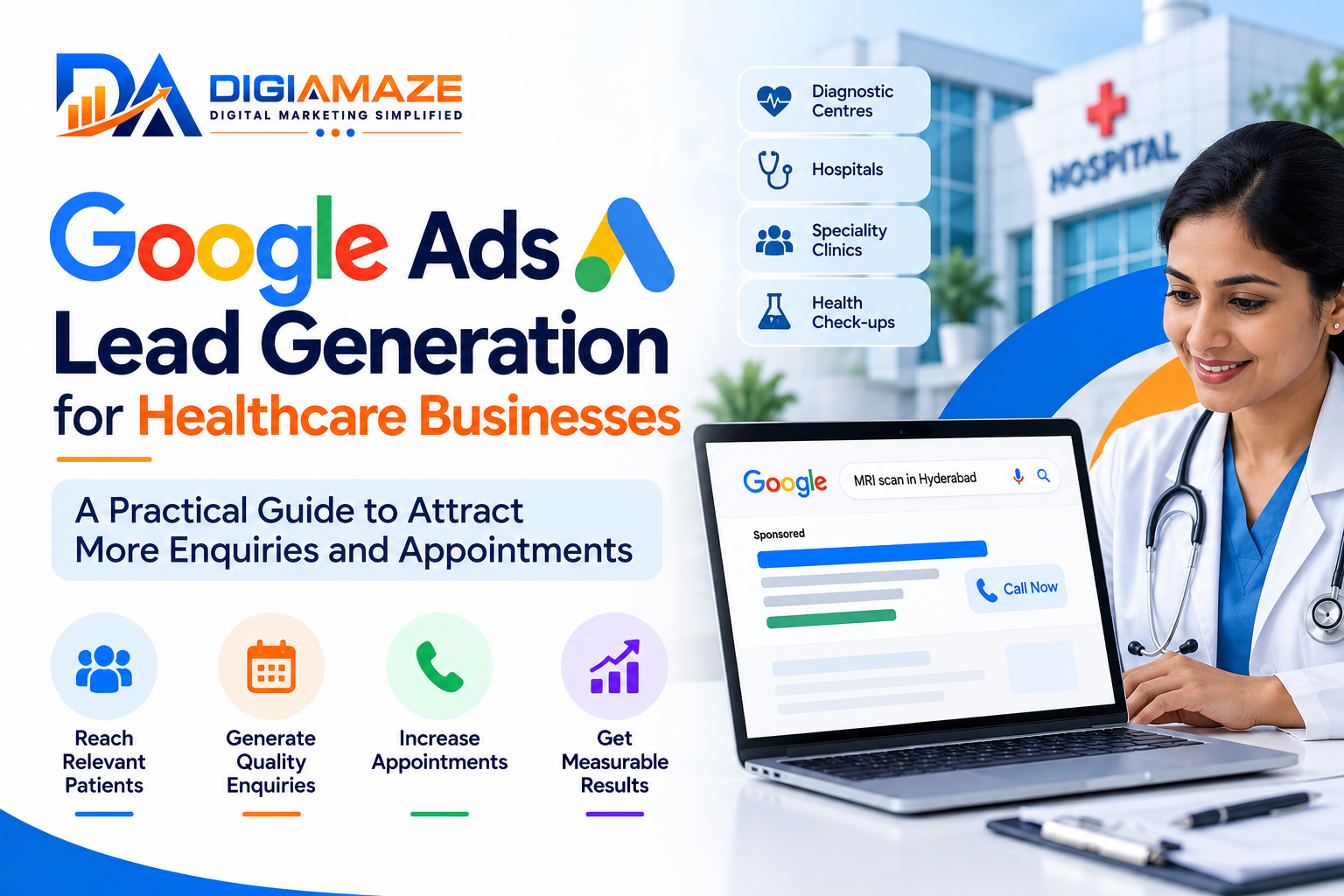
Google Ads Lead Generation for Healthcare Businesses: A Practical Guide
Healthcare businesses need more than website traffic to grow. Hospitals, diagnostic centres, clinics and speciality healthcare providers need to connect with people searching for relevant healthcare services and make it easy for them to find information, contact the facility or request an appointment.
Google Ads can help healthcare businesses reach people who are actively searching for services such as diagnostic tests, radiology scans, specialist consultations and hospital facilities. However, generating enquiries successfully requires the right campaign structure, relevant keywords, useful landing pages, accurate conversion tracking and careful attention to healthcare advertising policies.
In this guide, I’ll explain how healthcare businesses can use Google Ads for lead generation, improve campaign performance and focus on enquiries that contribute to business growth.
What Is Google Ads Lead Generation for Healthcare Businesses?
Google Ads lead generation involves using paid advertising to encourage potential customers to take a meaningful action, such as calling a healthcare facility, requesting an appointment or submitting an enquiry form.
For example, a diagnostic centre in Hyderabad may want to reach people searching for MRI scans, CT scans, blood tests or diagnostic services in its service area.
A hospital may want to generate enquiries for its available departments, while a speciality clinic may want to make its consultation process easier to discover.
The objective is not simply to generate clicks. It is to connect relevant search intent with accurate service information and a convenient next step.
1. Identify Your Healthcare Lead Generation Goals
Before launching a Google Ads campaign, define what success means for your healthcare business.
Different healthcare providers may have different objectives.
For example:
- Diagnostic centres: Relevant test enquiries, calls and bookings.
- Hospitals: Enquiries about departments, facilities and appointments.
- Speciality clinics: Consultation requests and appointment bookings.
- Radiology centres: Enquiries about available imaging services.
- Preventive healthcare providers: Enquiries about eligible health check-up services.
Avoid treating every click, call or form submission as an equally valuable lead.
A completed appointment or a qualified enquiry may be more meaningful than a visitor who opens a webpage and leaves without taking action.
Start by identifying the specific action you want potential customers to complete.
2. Choose the Right Google Ads Campaign Type
For many healthcare lead generation campaigns, Google Search Ads are a useful starting point because they can reach people searching for relevant services.
For example, a business might target searches related to:
- MRI scan services in Hyderabad
- CT scan centres near a relevant location
- Diagnostic services in Gachibowli
- Hospital appointment information
- Specialist clinic locations
The actual keywords should reflect the services offered, the business’s location and the customer’s search intent.
Other campaign types may be useful depending on the objective, available creative assets, audience strategy and advertising eligibility.
However, healthcare advertisers must review Google’s policies before selecting targeting methods or promoting restricted services. Health-related advertising can have additional restrictions, particularly for personalized advertising and certain medicines or treatments. <Cite refs={[“turn454920search0″,”turn454920search2”]}/>
3. Build a Relevant Keyword Strategy
Keyword research helps you understand how potential customers search for healthcare services.
Start by separating keywords into relevant groups.
Service-specific keywords
Examples include MRI scan, CT scan, blood tests and other services the facility actually provides.
Location-specific keywords
Examples include diagnostic centre in Hyderabad, MRI scan in Kukatpally and hospital near Gachibowli.
Appointment-related keywords
Examples include clinic appointment, diagnostic test booking and specialist consultation booking, where appropriate.
Use Google’s Keyword Planner and Search Terms reports to understand search demand and identify relevant queries.
Don’t add every healthcare-related keyword you find. Irrelevant terms can consume budget without generating useful enquiries.
Review search terms regularly and add negative keywords when they clearly don’t match the services offered.
For example, a diagnostic centre may need to exclude searches related to jobs, courses or equipment purchases if those searches are irrelevant to its business.
4. Create Clear and Relevant Ad Copy
Your advertisement should clearly explain the service being offered and provide an appropriate next step.
For example, an advertisement for a diagnostic facility might communicate:
- Available diagnostic services
- Facility location
- Appointment or enquiry options
- Relevant operational information
- A clear call to action
Use accurate descriptions and avoid exaggerated medical claims.
Don’t promise guaranteed medical outcomes, suggest that every person needs a particular test or use fear-based language to pressure people into booking services.
The advertisement and its landing page should communicate consistent information.
Healthcare advertisers should also review the applicable Google Ads healthcare policies and local legal or professional requirements before launching campaigns. <Cite refs={[“turn454920search2″,”turn454920search7”]}/>
5. Create Dedicated Landing Pages
Sending every advertisement to a generic homepage can make it harder for visitors to find the information they need.
Where appropriate, create dedicated landing pages for individual services or service categories.
For example, a diagnostic centre may have separate pages for MRI scans, CT scans and laboratory testing.
A useful landing page should include:
- Clear service information
- Facility location and contact details
- Available appointment or enquiry options
- Relevant operational information
- A simple mobile-friendly layout
- A clear next step
- Accurate and appropriately reviewed healthcare information
The page should answer the visitor’s immediate questions without requiring them to navigate through several unrelated pages.
Avoid publishing unsupported claims about diagnostic accuracy, treatment outcomes or medical benefits.
A well-designed landing page should make the next step easier while helping visitors understand the service accurately.
6. Target the Right Locations
Location targeting is especially important for healthcare businesses because patients and customers often prefer facilities within a practical travel distance.
A diagnostic centre in Hyderabad may focus on selected areas around its actual branches rather than targeting every location across Telangana.
For example, a facility serving Madhapur and nearby areas may test relevant location targeting for those areas before expanding.
Review Google’s location-targeting settings carefully. Depending on the campaign and available settings, location targeting can use different signals, so monitor where actual clicks and enquiries originate.
For multi-branch healthcare businesses, separate campaigns or clearly organized campaign structures can make it easier to assess performance by branch.
The goal is to spend the budget where the business can realistically serve the customer.
7. Optimize for Qualified Leads, Not Just Lead Volume
One of the biggest mistakes in Google Ads lead generation is judging performance only by the number of leads generated.
A campaign might produce many form submissions but few genuine enquiries or completed appointments.
For example, consider two campaigns:
| Metric | Campaign A | Campaign B |
|---|---|---|
| Enquiries | 100 | 50 |
| Qualified enquiries | 20 | 30 |
| Cost per enquiry | ₹200 | ₹300 |
| Total spend | ₹20,000 | ₹15,000 |
Campaign A generates more enquiries, but Campaign B generates more qualified enquiries at a lower total cost.
These are illustrative figures, but they demonstrate why lead quality matters.
Google Ads provides lead-generation guidance that recommends measuring meaningful stages of the lead journey and using appropriate conversion goals, such as qualified leads, converted leads or booked appointments. <Cite refs={[“turn454920search4”]}/>
Where reliable data is available, use this information to improve campaign decisions instead of optimizing for raw lead volume alone.
8. Set Up Conversion Tracking Properly
Without accurate conversion tracking, it is difficult to determine which campaigns are generating useful business outcomes.
Track meaningful actions such as:
- Completed enquiry forms
- Appointment requests
- Relevant calls
- Confirmed bookings, where measurable
- Qualified leads recorded in a CRM
- Completed appointments, where reliable data is available
Avoid counting every page view or button click as a successful lead.
For example, clicking a phone number is not necessarily the same as completing a meaningful call. Similarly, submitting an enquiry form does not automatically mean an appointment has been booked.
Google recommends establishing a strong measurement foundation and connecting lead stages to relevant campaign goals. Enhanced conversions for leads and offline conversion imports may help eligible advertisers connect advertising interactions with later business outcomes. <Cite refs={[“turn454920search4”]}/>
Healthcare advertisers should implement tracking in a way that respects privacy, applicable data-protection requirements and Google’s policies. Avoid sending patient health details or sensitive medical information to advertising platforms through URLs, analytics events or conversion parameters.
9. Follow Healthcare Advertising and Privacy Policies
Healthcare marketing requires particular care because advertisements can relate to sensitive personal information and regulated services.
Before launching campaigns, review:
- Google’s Healthcare and Medicines policy
- Google’s personalized advertising policy for health-related content
- Applicable Indian laws and professional advertising requirements
- Privacy and consent obligations
- Requirements for restricted services or advertiser certification
Some healthcare products and services are prohibited or restricted, and certain categories require additional approval. Rules vary by service and advertising location. <Cite refs={[“turn454920search2″,”turn454920search0”]}/>
Don’t assume that an advertisement is permitted simply because a competitor is running something similar.
Review the advertisement, landing page, keywords and targeting settings together.
For sensitive healthcare services, obtain appropriate compliance guidance before launching a campaign.
10. Measure Cost Per Lead, Appointment Cost and Return
A healthcare campaign should be evaluated using metrics that reflect its objective.
Useful metrics include:
Cost per lead (CPL): Total advertising spend divided by the number of leads generated.
Lead qualification rate: Qualified leads divided by total leads, multiplied by 100.
Appointment conversion rate: Completed bookings divided by the relevant lead or visitor group, depending on the measurement definition.
Cost per appointment: Advertising spend divided by the number of attributable appointments.
Return on advertising spend (ROAS): Attributable revenue divided by advertising spend, when revenue can be measured reliably.
For healthcare services, be careful when interpreting revenue because appointment value, service delivery costs and repeat visits can differ significantly.
A low cost per lead does not necessarily mean a profitable campaign. A more expensive lead may be valuable if it results in a completed, appropriate appointment.
Review performance by service, location, campaign and lead quality to understand where improvements are needed.
11. Improve Campaigns Through Regular Optimization
Google Ads lead generation requires ongoing review.
A practical optimization routine includes:
- Reviewing search terms and excluding irrelevant queries.
- Comparing campaign performance by service and location.
- Checking landing-page experience and mobile usability.
- Reviewing lead quality with the reception or appointment team.
- Testing relevant ad messaging.
- Checking conversion tracking for errors.
- Adjusting budgets based on reliable performance data.
- Monitoring disapproved ads and policy alerts.
Make changes based on sufficient evidence rather than reacting to every short-term fluctuation.
For larger healthcare businesses, CRM integration can help connect campaign data with the lead management process, subject to appropriate privacy safeguards.
The objective is to build a repeatable system that improves the quality and efficiency of lead generation over time.
Final Thoughts
Google Ads can be a valuable channel for healthcare businesses that want to reach people searching for relevant services.
However, successful lead generation requires more than increasing advertising spend.
It depends on relevant keywords, accurate ad copy, useful landing pages, appropriate location targeting, reliable conversion tracking, lead qualification and compliance with healthcare advertising policies.
As a Digital Marketing Consultant in Hyderabad, India, I recommend evaluating healthcare advertising through the complete customer journey:
Relevant search → Useful advertisement → Service information → Enquiry → Qualified lead → Appointment → Measurable business outcome
When every stage is planned carefully, healthcare businesses can make more informed advertising decisions and build a more sustainable approach to digital lead generation.
About the Author
Kotla Ranjith Kumar Reddy is a Digital Marketing Consultant in Hyderabad, India, specializing in SEO, Google Ads, Meta Ads, local SEO, performance marketing, lead generation and marketing automation.
Through DigiAmaze, he focuses on helping businesses improve online visibility, attract relevant audiences and develop digital marketing strategies centered on measurable growth.
Website: https://www.digiamaze.com/