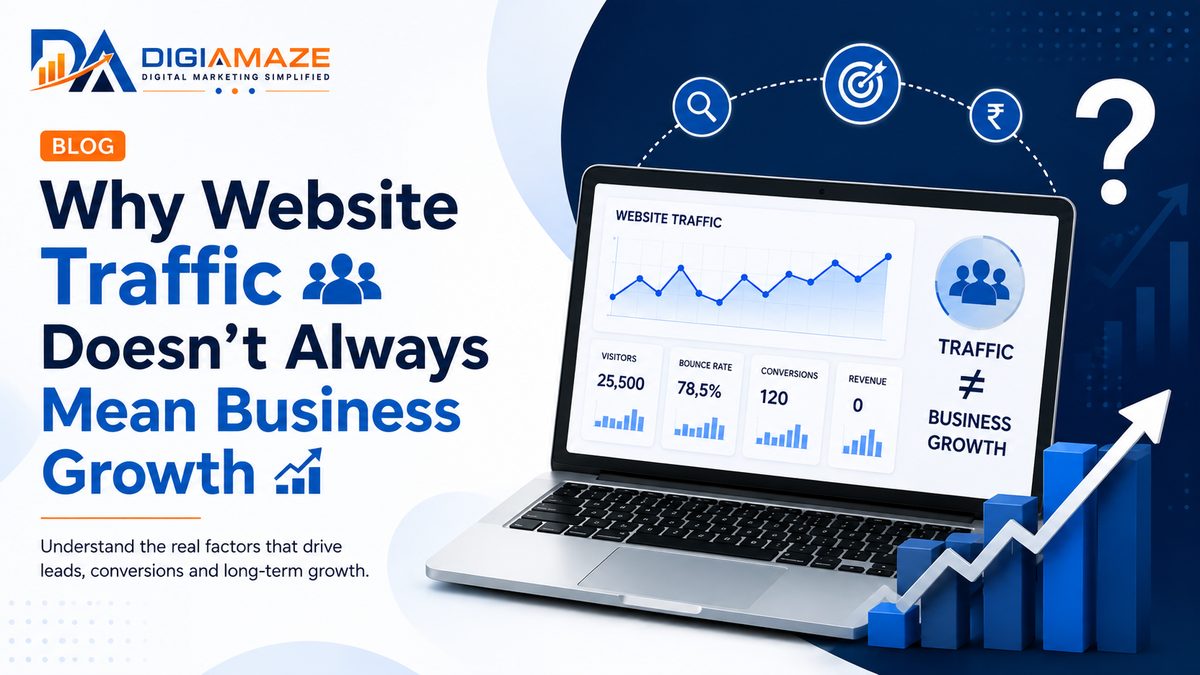
Why Website Traffic Doesn’t Always Mean Business Growth
Getting more visitors to your website sounds like a clear sign of success. After all, more traffic should mean more potential customers, more enquiries, and more revenue.
But that is not always the case.
A website can receive thousands of visitors every month and still generate very few leads or sales. At the same time, another website with a much smaller audience can produce significantly better business results.
The reason is simple: website traffic is only one part of digital marketing success.
What really matters is whether the right people are visiting your website, whether they find what they need, and whether your website encourages them to take the next step.
As a Digital Marketing Consultant, I often see businesses focus heavily on increasing website traffic while overlooking what happens after a visitor lands on the website.
In this article, we will look at why high website traffic does not always translate into business growth and what businesses can do to turn website visitors into meaningful results.
What Does Website Traffic Actually Mean?
Website traffic refers to the number of people who visit your website through different channels.
Visitors may come from:
- Google and other search engines
- Paid advertising
- Social media
- Direct searches
- Referral websites
- Email marketing
- Online directories
- Other digital marketing campaigns
Traffic is useful because it tells you that people are reaching your website.
However, traffic alone does not tell you whether those visitors are actually interested in your products or services.
For example, imagine a website receives 50,000 visitors per month, but only 100 people submit an enquiry.
Another website receives 5,000 visitors, but 300 people contact the business.
Which website is performing better?
The second website may have significantly better marketing performance because it is attracting a more relevant audience and converting visitors more effectively.
1. More Traffic Doesn’t Always Mean More Relevant Traffic
One of the biggest reasons traffic fails to generate business is poor audience targeting.
Not every website visitor is a potential customer.
A visitor may be:
- Looking for general information
- Researching a topic
- Comparing different companies
- Searching for a free solution
- Visiting your website accidentally
- Located in a market you do not serve
- Looking for a completely different service
For example, if you provide premium B2B services but your website attracts mostly students looking for basic information, your traffic numbers may look impressive.
But those visitors are unlikely to become customers.
Quality Matters More Than Quantity
Instead of asking:
“How many visitors came to my website?”
Businesses should also ask:
“How many relevant potential customers visited my website?”
This shift in thinking can completely change how you evaluate digital marketing performance.
2. Your Website May Not Match Search Intent
People visit websites for different reasons.
Someone searching for:
“What is digital marketing?”
has a different intention from someone searching for:
“Digital marketing consultant in India.”
The first person may simply want information.
The second person may be actively looking for a service provider.
This is known as search intent.
Your content, landing pages, and calls-to-action should match the intent behind the keywords you’re targeting.
If your website ranks for informational keywords but provides no clear path toward your services, you may receive substantial organic traffic without generating many enquiries.
3. A High Bounce Rate Can Be a Warning Sign
When visitors arrive at your website and leave without exploring further, it can indicate that the page did not meet their expectations.
There can be many reasons for this.
For example:
- The page loads slowly
- The content is difficult to understand
- The headline does not match the search query
- The website is difficult to navigate
- The page looks outdated
- The visitor cannot immediately understand what you offer
- There is no clear next step
- The content is too promotional
- The website does not work properly on mobile devices
Getting someone to your website is only the beginning.
The real challenge is giving them a reason to stay.
4. Your Website May Have a Conversion Problem
A website can have excellent traffic but poor conversions.
This usually happens when visitors don’t know what to do next.
Every important service page should have a clear purpose.
Depending on the business, the desired action could be:
- Contact us
- Request a consultation
- Book an appointment
- Call the business
- Submit an enquiry
- Download a resource
- Request a quotation
- Purchase a product
- Start a free trial
A strong call-to-action (CTA) helps visitors understand the next step.
For example, instead of ending a service page with:
“Thank you for visiting our website.”
a business could use:
“Looking for a Digital Marketing Consultant? Get in touch to discuss your marketing goals.”
The CTA should be relevant to the visitor’s stage in the buying journey.
5. Your Landing Page May Be Losing Potential Customers
Paid advertising can bring highly targeted visitors to your website.
But if the landing page is poorly designed, advertising money can be wasted.
A good landing page should quickly answer three questions:
What do you offer?
Who is it for?
Why should the visitor choose you?
The visitor should not have to search through several pages to understand your service.
A strong landing page generally includes:
- A clear headline
- Relevant information
- Benefits of the service
- Supporting proof
- Testimonials or case studies where appropriate
- Trust signals
- A clear CTA
- Easy contact options
- Mobile-friendly design
The goal is not simply to attract visitors.
The goal is to help the right visitors make a decision.
6. Your Traffic Sources May Be Working Differently
Not all traffic channels perform in the same way.
For example, visitors from:
Organic Search may be researching a problem or actively looking for a service.
Paid Search visitors may have stronger commercial intent.
Social Media visitors may be discovering your brand for the first time.
Referral Traffic may already have some level of trust because they came through another website.
Because of these differences, businesses should evaluate traffic by source.
Look beyond total sessions and examine:
- Engagement
- Leads
- Conversion rate
- Cost per lead
- Sales
- Revenue
- Customer acquisition cost
- Return on advertising spend
This gives you a much clearer picture of what your marketing is actually delivering.
7. Ranking for the Wrong Keywords Can Increase Traffic but Reduce Leads
SEO is not simply about ranking for keywords with large search volumes.
A keyword may receive thousands of searches but generate very little business for you.
Consider two keywords:
“Digital marketing”
and
“Digital marketing consultant in Chennai.”
The first keyword is extremely broad.
The second keyword is more specific and indicates a stronger possibility of someone looking for a service.
This is why an effective SEO strategy should focus on a combination of:
- Search volume
- Search intent
- Relevance
- Competition
- Commercial value
- Geographic targeting
The objective should be to attract qualified organic traffic, not traffic for the sake of increasing a number in Google Analytics.
8. Trust Plays a Major Role in Conversion
Visitors rarely become customers simply because they found your website.
They need confidence in your business.
Trust can come from:
- Customer reviews
- Testimonials
- Case studies
- Industry experience
- Author information
- Clear business information
- Transparent service details
- Professional website design
- Useful educational content
- Strong online presence
For professional services, demonstrating expertise is particularly important.
Publishing useful content can help potential customers understand your knowledge before they contact you.
9. Content Should Help Customers, Not Just Search Engines
Many businesses create blog articles primarily to rank for keywords.
That approach can produce content that feels repetitive, unnatural, or overly optimized.
A better approach is to create content that genuinely answers customer questions.
For example, instead of writing an article simply targeting:
“Digital Marketing Consultant”
you could create useful topics such as:
- Why Website Traffic Doesn’t Always Mean Business Growth
- How to Improve Website Conversion Rates
- SEO vs Google Ads: Which Is Better for Your Business?
- How Much Does Digital Marketing Cost?
- Why Your Website Gets Traffic but No Leads
- How to Choose the Right Digital Marketing Consultant
- Common SEO Mistakes Businesses Should Avoid
This type of content can attract people at different stages of the buying journey.
10. Business Growth Requires More Than Traffic
A successful digital marketing strategy connects multiple elements.
Think of it as a journey:
Target Audience → Search/Ad → Website → Content → Trust → Conversion → Lead → Customer → Repeat Business
If one part of this journey is weak, increasing traffic may not solve the underlying problem.
For example:
More traffic + poor landing page = more visitors leaving
More traffic + wrong audience = low-quality leads
More traffic + weak CTA = missed opportunities
More traffic + poor follow-up = lost customers
This is why businesses need to look at the entire marketing funnel instead of focusing on a single metric.
What Metrics Should Businesses Track?
Instead of focusing only on website visitors, consider tracking metrics that connect marketing activity with business outcomes.
Important Website Metrics
- Users and sessions
- Engagement rate
- Landing-page performance
- Traffic sources
- New vs returning visitors
- Device performance
- Geographic traffic
Lead Generation Metrics
- Number of enquiries
- Conversion rate
- Qualified leads
- Cost per lead
- Lead-to-customer rate
Business Metrics
- Sales generated
- Revenue
- Customer acquisition cost
- Return on investment
- Customer lifetime value
The most important question is:
“Is digital marketing contributing to business growth?”
That is much more valuable than simply asking whether website traffic increased.
How to Turn Website Traffic Into Business Growth
If your website receives traffic but generates fewer leads than expected, consider these steps.
Step 1: Understand Your Target Audience
Identify who your ideal customers are, what problems they have, and what they are searching for.
Step 2: Review Search Intent
Check whether the keywords bringing visitors to your website match your products and services.
Step 3: Improve Your Landing Pages
Make your value proposition clear and provide a simple path toward conversion.
Step 4: Strengthen Your Calls-to-Action
Tell visitors exactly what they can do next.
Step 5: Build Trust
Use genuine reviews, testimonials, case studies, author information, and useful content where appropriate.
Step 6: Analyze Conversion Data
Don’t stop at traffic reports. Identify which pages and channels generate actual leads and customers.
Step 7: Optimize Continuously
Digital marketing is not a one-time activity.
Test headlines, landing pages, advertisements, content, CTAs, and targeting to understand what produces better results.
The Bottom Line
Website traffic is important, but traffic is not the same as business growth.
A website can have thousands of visitors and still struggle to generate leads. Meanwhile, a smaller website with the right audience, strong content, a clear value proposition, and an effective conversion strategy can generate significantly better business results.
The goal of digital marketing should therefore not be:
“How can I get more website visitors?”
The better question is:
“How can I attract the right people and convert their interest into measurable business results?”
When SEO, paid advertising, content marketing, website experience, conversion optimization, and lead follow-up work together, website traffic becomes much more valuable.
About Kotla Ranjith Kumar Reddy
Kotla Ranjith Kumar Reddy is a Digital Marketing Consultant focused on helping businesses improve their online visibility, generate qualified leads, and build measurable digital marketing strategies.
Through a combination of SEO, Google Ads, social media marketing, content marketing, website optimization, and performance marketing, businesses can build a stronger digital presence and focus on marketing activities that contribute to real business outcomes.
As a Digital Marketing Consultant, Kotla Ranjith Kumar Reddy provides digital marketing services for businesses across India, the USA, the UK, Canada, Australia, and Singapore.
If your website is getting traffic but not generating enough leads or customers, the right digital marketing strategy can help identify where visitors are being lost and what needs to be improved.
Looking for a Digital Marketing Consultant?
If you are looking for a Digital Marketing Consultant in India, USA, UK, Canada, Australia, or Singapore, you can learn more about digital marketing services and consultation at:
Digital Marketing Consultant – Digiamaze
Visit Digital Marketing Consultant – Digiamaze
Author: Kotla Ranjith Kumar Reddy
Profession: Digital Marketing Consultant
Service Areas: India | USA | UK | Canada | Australia | Singapore