Biggest Digital Marketing Trends for Real Estate and Healthcare Businesses in India in 2026
Digital marketing in India is changing rapidly in 2026. Search is becoming more conversational and AI-powered, customers are using multiple digital channels before making decisions, and businesses are placing greater emphasis on measurable leads and conversions rather than simply generating traffic.
For real estate and healthcare businesses, these changes are particularly important. Both industries involve high-consideration decisions where customers typically research extensively before contacting a property developer, hospital, diagnostic centre, doctor or healthcare provider.
Google says Google and YouTube are present in 93% of consumer journeys for discovering a new brand, product or retailer in India, while its 2026 Search and advertising developments increasingly use AI to understand complex, conversational intent.
So, what should real estate and healthcare businesses in India focus on in 2026?
Let’s look at the biggest trends.
1. AI Search and Answer Engine Optimisation (AEO)
One of the biggest changes in 2026 is the evolution of search from traditional keyword-based results toward AI-powered, conversational search.
People are increasingly asking detailed questions instead of searching only for short keywords.
For example:
Traditional search:
“Best cardiologist Hyderabad”
AI-style search:
“Which cardiologist in Hyderabad is suitable for someone looking for preventive heart care?”
Similarly, a property buyer may ask:
“Which areas in Hyderabad are best for buying a 3 BHK apartment for investment in 2026?”
Google’s AI Search developments are designed to understand longer, more complex and multimodal queries. Google reports that the average AI Mode query is around three times longer than a traditional search query.
What this means for businesses
Traditional SEO alone is no longer enough.
Businesses should also think about AEO (Answer Engine Optimisation) and, more broadly, visibility across AI-powered search experiences.
For healthcare
Create authoritative content around:
- Medical conditions
- Diagnostic tests
- Symptoms
- Treatment information
- Doctor specialities
- Test preparation
- Frequently asked questions
- Location-specific healthcare services
For real estate
Create useful content around:
- Property investment
- Locality comparisons
- Property prices
- Rental yields
- Home loans
- Buying guides
- Project comparisons
- Infrastructure developments
- Frequently asked buyer questions
The goal is to become a credible source of information, not simply to insert keywords into articles.
2. Local SEO and Google Business Profile
For both industries, local search remains extremely important.
Healthcare is particularly local.
People search for:
- Diagnostic centre near me
- MRI scan near me
- Hospital near me
- Dentist near me
- Health checkup near me
- Pathology lab near me
Real estate is also becoming increasingly hyperlocal.
Instead of targeting only “real estate in Hyderabad”, marketers can target searches around specific locations such as:
- Kokapet
- Narsingi
- Gachibowli
- Financial District
- Tellapur
- Kondapur
- Bachupally
A strong local SEO strategy should include:
- Google Business Profile optimisation
- Location pages
- Accurate contact information
- Reviews
- Photos and videos
- Local keywords
- Local content
- Internal linking
- Consistent business information
For healthcare businesses with multiple branches, individual location pages and properly managed local profiles can be particularly valuable.
3. AI-Powered Google Ads and Performance Marketing
Google Ads is also changing rapidly.
Google’s 2026 advertising updates place Gemini and AI-powered campaign capabilities at the centre of Search, YouTube and other advertising surfaces. Google says AI Max for Search can help campaigns reach additional relevant searches beyond traditional keyword targeting.
This means advertisers need to focus less on manually controlling every individual keyword and more on:
- High-quality conversion data
- Strong creative assets
- Accurate conversion tracking
- Audience signals
- Landing-page quality
- Qualified-lead data
- First-party data
For real estate
Campaigns can focus on:
Search Ad → Landing Page → WhatsApp/Call → Qualification → Site Visit → Booking
For healthcare
Campaigns can focus on:
Search Ad → Service Page → Call/WhatsApp → Appointment → Patient Visit
The important point is that lead generation should not be the final KPI.
4. Qualified Leads Are More Important Than Cheap Leads
In 2026, businesses need to move beyond simply reporting:
“We generated 5,000 leads.”
The better question is:
How many of those leads became customers or appointments?
Real estate funnel
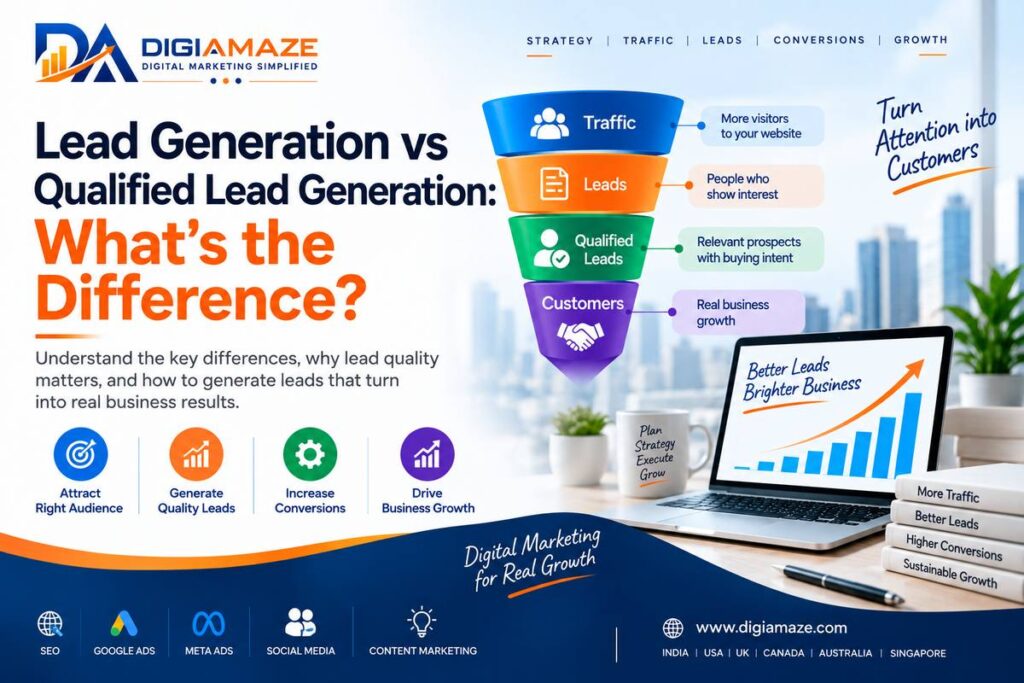
Lead → Qualified Lead → Site Visit → Booking → Revenue
Healthcare funnel
Enquiry → Qualified Patient → Appointment → Visit → Revenue
For example, a real estate campaign generating leads at ₹150 each may look attractive. But if another campaign generates leads at ₹400 with significantly more site visits and bookings, the second campaign could be far more profitable.
The same principle applies to healthcare.
Cost per lead is useful. Cost per qualified lead and cost per acquisition are better.
5. WhatsApp Marketing and Conversational Marketing
WhatsApp is particularly important in the Indian market because customers are comfortable using messaging for enquiries, follow-ups and service communication.
Instead of forcing every customer through a long website form, businesses can create shorter journeys.
Real estate example
Instagram/Google Ad → WhatsApp → Project Information → Budget Qualification → Site Visit
Healthcare example
Google Search → WhatsApp → Test/Service Enquiry → Branch Selection → Appointment
Businesses can also use automation for:
- FAQs
- Lead qualification
- Appointment reminders
- Site-visit reminders
- Follow-ups
- Brochure/project information
- Location information
However, automation should be connected to a broader customer-data and CRM strategy rather than functioning as an isolated chatbot. Recent research on Indian enterprises highlights the importance of connecting AI, messaging channels, customer data and governance.
6. Short-Form Video Marketing
Video continues to be one of the strongest ways to explain complex products and services.
Real estate businesses can create:
- Property walkthroughs
- 30-second project tours
- Locality videos
- Construction updates
- Customer testimonials
- “Why invest here?” videos
- Price and configuration explainers
- Infrastructure updates
Healthcare businesses can create:
- Doctor-led educational videos
- Test preparation videos
- Health awareness videos
- Myth vs. fact videos
- Diagnostic procedure explainers
- Facility walkthroughs
- Patient experience content
The key difference in 2026 is that businesses shouldn’t create videos simply because “video is trending.”
Each video should have a search, education, trust or conversion purpose.
7. First-Party Data and CRM Integration
Another major trend is the move toward better use of first-party customer data.
Real estate businesses can connect:
Google Ads + Meta Ads + Website + WhatsApp + CRM + Sales Team
Healthcare organisations can connect:
Google Ads + Website + Calls + WhatsApp + Appointment System + CRM
This enables businesses to understand:
- Which campaigns generate enquiries
- Which campaigns generate qualified leads
- Which locations perform best
- Which services generate demand
- Which leads convert
- Where leads are being lost
This is a major step toward data-driven digital marketing.
8. Hyperlocal and Regional-Language Marketing
India is not one single digital market.
Businesses increasingly need to consider:
- English
- Hindi
- Telugu
- Tamil
- Kannada
- Malayalam
- Marathi
- Bengali
- Other regional languages
For real estate, regional-language content can help reach buyers and families researching property.
For healthcare, multilingual educational content can make complex medical information easier to understand.
Google’s India leadership has also highlighted the growing importance of Tier-2, Tier-3 and rural markets in India’s next phase of digital growth.
9. Trust, Reviews and Online Reputation
For high-consideration industries, trust is a marketing asset.
This is particularly important for healthcare.
A potential patient may check:
- Google reviews
- Doctor profiles
- Hospital/diagnostic centre information
- Website content
- Location
- Patient experiences
- Social media
- Search results
Real estate buyers similarly research:
- Developer reputation
- Project reviews
- Customer experiences
- RERA information
- Location
- Construction progress
- Online discussions
Therefore, reputation management should be treated as part of the customer acquisition strategy, not as a separate activity.
10. AI-Assisted Personalisation
AI allows marketers to create more relevant experiences at scale.
For example, a real estate business could show different content to:
First-time buyer → Investment buyer → Luxury buyer → NRI buyer
A healthcare organisation could create different journeys for:
Preventive health → Women’s health → Senior health → Cardiac diagnostics → Diabetes testing
The objective isn’t simply to use AI.
The objective is to use AI to make the customer journey more relevant and useful.
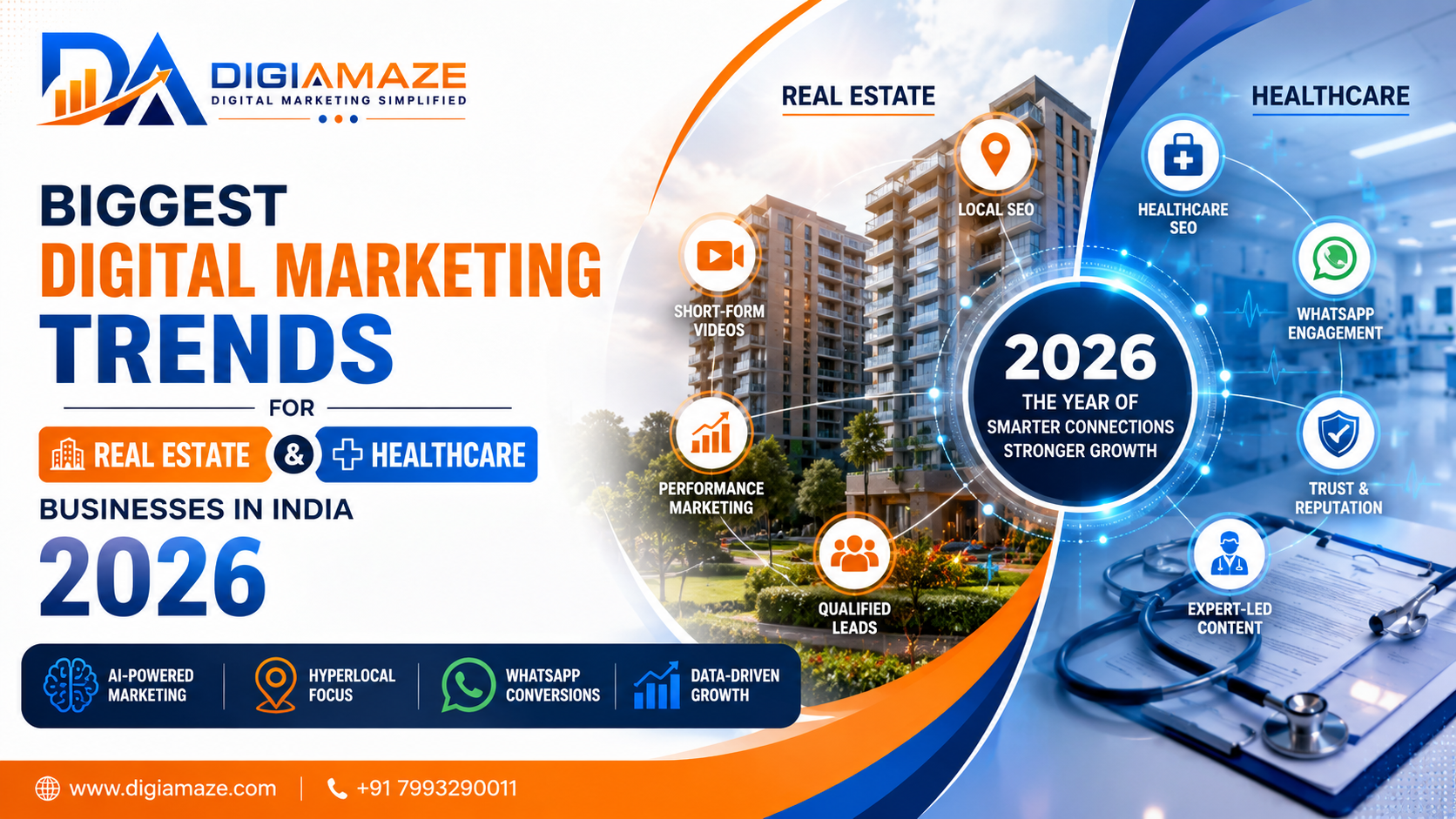
Top Digital Marketing Priorities for Real Estate in 2026
For real estate businesses in India, I would prioritise:
- AI Search and AEO
- Google Ads and AI-powered campaign optimisation
- Hyperlocal SEO
- WhatsApp lead generation
- Short-form property video
- CRM-based lead qualification
- Site-visit conversion tracking
- Regional-language marketing
- Property comparison and locality content
- Customer testimonials and reputation management
AI is already being used in Indian real estate for virtual property tours, chatbots, personalised recommendations and digital marketing optimisation, with its role expanding further across the industry.
Top Digital Marketing Priorities for Healthcare in 2026
For healthcare businesses, I would prioritise:
- AI Search and AEO
- Healthcare SEO
- Google Business Profile and Local SEO
- Doctor/expert-led content
- Google Ads for high-intent services
- WhatsApp and conversational enquiries
- Online reputation management
- Appointment conversion tracking
- Regional-language health education
- Trustworthy, evidence-based content
Healthcare also has a broader AI transformation happening across India’s digital-health ecosystem, making trust, privacy, consent and responsible use of AI increasingly important alongside marketing innovation.
Real Estate vs Healthcare: Where Should Marketers Focus?
| Digital Trend | Real Estate | Healthcare |
|---|---|---|
| AI Search / AEO | ⭐⭐⭐⭐⭐ | ⭐⭐⭐⭐⭐ |
| Local SEO | ⭐⭐⭐⭐ | ⭐⭐⭐⭐⭐ |
| Google Ads | ⭐⭐⭐⭐⭐ | ⭐⭐⭐⭐⭐ |
| ⭐⭐⭐⭐⭐ | ⭐⭐⭐⭐⭐ | |
| Short-form Video | ⭐⭐⭐⭐⭐ | ⭐⭐⭐⭐ |
| CRM & Lead Tracking | ⭐⭐⭐⭐⭐ | ⭐⭐⭐⭐⭐ |
| Reviews & Reputation | ⭐⭐⭐⭐ | ⭐⭐⭐⭐⭐ |
| Regional Language | ⭐⭐⭐⭐ | ⭐⭐⭐⭐⭐ |
| AI Personalisation | ⭐⭐⭐⭐⭐ | ⭐⭐⭐⭐ |
| Expert-led Content | ⭐⭐⭐ | ⭐⭐⭐⭐⭐ |
Conclusion
The biggest digital marketing trend in India in 2026 is not simply “using AI.”
It is the transition from channel-based marketing to intelligent, connected customer journeys.
For real estate, that means connecting:
AI Search + SEO + Google Ads + Video + WhatsApp + CRM + Site Visits + Sales
For healthcare, it means connecting:
AI Search + Healthcare SEO + Local SEO + Google Ads + Expert Content + WhatsApp + Appointments + Reputation
Businesses that continue to measure only website traffic, impressions and leads may struggle to understand their actual marketing performance.
The businesses that connect discovery → engagement → qualified lead → conversion → revenue will have a much stronger advantage in 2026.
For digital marketing agencies and consultants, this creates a major opportunity: instead of selling individual services such as SEO, Google Ads or social media management, the focus can shift toward AI-first digital growth strategies that connect marketing activity to measurable business outcomes. Google’s 2026 marketing direction itself reflects this movement toward AI-powered discovery, campaign optimisation and measurement.