Lead Generation vs Qualified Lead Generation: What’s the Difference?
Lead generation is one of the most important goals of digital marketing. Businesses invest in SEO, Google Ads, social media, content marketing, landing pages, and other channels to attract potential customers.
But there is an important difference between generating leads and generating qualified leads.
A business may receive hundreds of enquiries every month and still struggle to increase sales if most of those enquiries are irrelevant, have low buying intent, or don’t match the company’s target customer.
That is why modern digital marketing should focus not only on how many leads you generate, but also on how valuable those leads are.
In this article, let’s understand the difference between lead generation and qualified lead generation, why lead quality matters, and how businesses can improve their lead generation strategy.
What Is Lead Generation?
Lead generation is the process of attracting people who show interest in a business, product, or service and collecting their contact information or encouraging them to take an action.
A lead can be generated through several digital channels, including:
- Google Search
- Google Ads
- SEO
- Social media marketing
- Facebook and Instagram advertising
- LinkedIn marketing
- Content marketing
- Landing pages
- Email marketing
- WhatsApp campaigns
- Website enquiry forms
- Phone calls
- Online directories
For example, if someone visits your website and fills out a contact form requesting more information, that person becomes a lead.
However, not every lead is automatically a potential customer.
This is where qualified lead generation becomes important.
What Is Qualified Lead Generation?
Qualified lead generation focuses on attracting and identifying prospects who are more likely to become customers.
A qualified lead generally matches important criteria such as:
- They need the product or service.
- They belong to your target audience.
- They have genuine interest.
- They meet your location requirements.
- They have an appropriate budget.
- They have buying intent.
- They have the authority to make or influence the purchasing decision.
- They are looking for a solution within a relevant timeframe.
In simple terms:
Lead generation = Getting potential enquiries.
Qualified lead generation = Getting enquiries from people who are more likely to become customers.
Lead Generation vs Qualified Lead Generation
The difference becomes clearer when we compare the two.
| Lead Generation | Qualified Lead Generation |
|---|---|
| Focuses on generating enquiries | Focuses on generating relevant enquiries |
| Prioritizes lead volume | Prioritizes lead quality |
| May include many low-intent prospects | Targets higher-intent prospects |
| Can produce a large database | Produces a more valuable sales pipeline |
| Focuses on initial interest | Focuses on potential business value |
| Useful for building awareness | More closely connected to sales |
A campaign generating 1,000 leads may look successful.
But if only 20 are genuinely interested in purchasing, the actual business value may be limited.
On the other hand, a campaign generating 200 leads with 80 highly relevant prospects could potentially deliver much stronger results.
The objective should not always be more leads. The objective should be better leads.
Why Do Businesses Get Low-Quality Leads?
There are several reasons why a business may receive a high number of leads but very few qualified prospects.
1. Broad Audience Targeting
If your advertising reaches almost everyone, you may generate a large number of enquiries from people who aren’t your ideal customers.
Targeting should be based on factors such as:
- Location
- Age and demographics where relevant
- Interests
- Industry
- Job role
- Customer needs
- Search behaviour
- Buying intent
The more accurately you define your target audience, the better your chances of generating relevant leads.
2. Choosing the Wrong Keywords
SEO and Google Ads can generate significant traffic and enquiries, but keyword selection matters.
For example, someone searching:
“What is digital marketing?”
is probably looking for information.
Someone searching:
“Digital marketing consultant in Hyderabad”
may have a much stronger commercial intention.
This is why businesses should consider search intent when selecting keywords.
A good keyword strategy balances:
- Relevance
- Search intent
- Competition
- Search volume
- Commercial value
- Geographic relevance
3. Poor Landing Page Messaging
Your landing page plays an important role in lead quality.
If your advertisement promises one thing but the landing page communicates something completely different, visitors may become confused or submit enquiries without understanding the actual service.
A strong landing page should clearly explain:
What you offer
Who you help
What problem you solve
Why customers should consider your service
What action they should take next
Clear messaging can help filter out irrelevant enquiries while attracting people who genuinely need your service.
4. Weak Lead Forms
Your lead form can also influence lead quality.
If you only ask for:
Name + Phone Number
you may receive a large number of enquiries but have very little information about the prospect.
Depending on your business, you could ask relevant qualifying questions such as:
- What service are you interested in?
- What is your business type?
- What is your location?
- What is your approximate budget?
- What is your requirement?
- When are you planning to start?
You don’t need to make every form complicated.
The goal is to collect enough information to understand whether the enquiry is relevant.
5. Optimizing Campaigns Only for Lead Volume
This is a common digital marketing mistake.
Suppose Campaign A generates:
500 leads at ₹200 per lead
while Campaign B generates:
150 leads at ₹500 per lead
At first glance, Campaign A looks better because it generated more leads at a lower cost.
But imagine that Campaign A produces only 10 customers while Campaign B produces 30 customers.
Campaign B may actually be much more valuable to the business.
This is why marketers should evaluate campaigns based on business outcomes, not just lead volume.
What Is a Marketing Qualified Lead?
A Marketing Qualified Lead (MQL) is a prospect who has demonstrated enough interest or meets enough criteria to be considered more valuable than a general lead.
For example, a prospect might:
- Visit multiple service pages
- Download a detailed resource
- Request pricing
- Submit a detailed enquiry
- Engage repeatedly with marketing content
- Match your target customer profile
The exact definition of an MQL depends on the business.
What Is a Sales Qualified Lead?
A Sales Qualified Lead (SQL) is generally a prospect who has been assessed as having stronger potential to become a customer and is ready for sales engagement.
For example, the prospect may:
- Have a clear requirement
- Have an appropriate budget
- Be actively considering a purchase
- Have decision-making authority
- Have a suitable timeline
The transition from lead to MQL to SQL helps marketing and sales teams prioritize their efforts.
How to Generate More Qualified Leads
Generating better leads requires alignment between your marketing strategy and your sales objectives.
1. Define Your Ideal Customer
Before launching campaigns, identify your ideal customer.
Understand:
- Who they are
- What problem they have
- What they are searching for
- Where they are located
- What motivates them
- What objections they may have
- What influences their buying decision
2. Build Intent-Based Keyword Strategies
Don’t focus only on keywords with high search volume.
Look for keywords that indicate genuine interest in your product or service.
For SEO and paid search, consider different stages of the customer journey:
Informational intent → Commercial research → Transactional intent
Your content and campaigns should support each stage.
3. Create Dedicated Landing Pages
Instead of sending every advertisement to your homepage, consider creating landing pages specifically for different services, audiences, locations, or campaigns.
For example:
Digital Marketing Consultant in Hyderabad
can have a dedicated landing page explaining the services, expertise, process, benefits, FAQs, and contact options relevant to that audience.
4. Use Strong Calls-to-Action
Your CTA should make the next step clear.
Examples include:
- Get a Free Consultation
- Request a Quote
- Book a Consultation
- Talk to an Expert
- Get Started
- Request More Information
A clear CTA can reduce friction and improve conversion opportunities.
How to Measure Qualified Lead Generation
Don’t stop at Cost Per Lead (CPL).
Track the complete funnel:
Website Visitors → Leads → Qualified Leads → Sales Opportunities → Customers → Revenue
Important metrics include:
Lead Conversion Rate
How many website visitors become leads?
Lead Qualification Rate
What percentage of leads meet your qualification criteria?
Cost Per Qualified Lead
How much are you spending to generate a genuinely relevant lead?
Lead-to-Customer Rate
How many qualified leads eventually become customers?
Customer Acquisition Cost
How much does it cost to acquire a customer?
Revenue Generated
How much business revenue can be connected to your marketing activities?
These metrics provide a much clearer understanding of marketing performance.
Why Lead Quality Matters More Than Lead Quantity
A large number of leads can create unnecessary pressure for sales teams.
Sales representatives may spend valuable time contacting people who:
- Aren’t interested
- Don’t need the service
- Don’t fit the target audience
- Don’t have the required budget
- Are outside the service area
- Are only looking for free information
Qualified lead generation helps marketing and sales teams focus their time on prospects with stronger potential.
This can improve:
Marketing efficiency + Sales productivity + Conversion rates + Customer acquisition + Business growth
Marketing and Sales Should Work Together
Qualified lead generation works best when marketing and sales teams agree on what a good lead actually means.
Marketing should understand:
Who should we target?
Sales should explain:
Which leads are actually converting?
Both teams should regularly review:
- Lead quality
- Lead sources
- Conversion rates
- Customer feedback
- Sales outcomes
- Revenue contribution
This creates a feedback loop that can continuously improve digital marketing campaigns.
The Bottom Line
Lead generation is important, but lead volume should not be the only measure of success.
A business doesn’t grow simply because it receives more enquiries.
Growth comes from attracting the right prospects, converting them into qualified opportunities, and ultimately turning those opportunities into customers.
The real journey is:
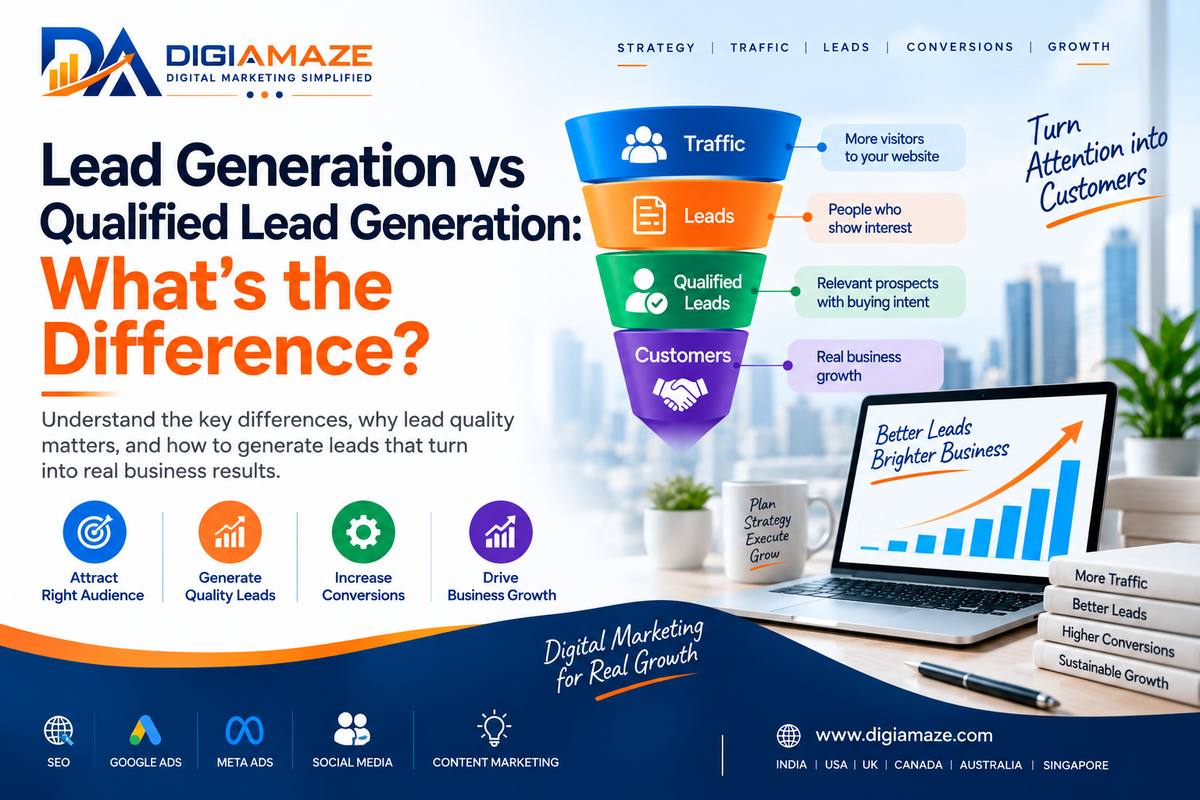
Traffic → Leads → Qualified Leads → Customers → Revenue
If your business is generating hundreds of leads but only a small percentage become customers, don’t immediately focus on generating even more leads.
First ask:
Are we generating the right leads?
That question can reveal opportunities to improve your targeting, keywords, landing pages, offers, lead forms, follow-up process, and overall marketing strategy.
Better leads can create better sales opportunities—and better sales opportunities can create stronger business growth.
About the Author
Kotla Ranjith Kumar Reddy is a Digital Marketing Consultant in Hyderabad, helping businesses build practical digital marketing strategies focused on visibility, lead generation, conversions, and measurable business growth.
Digital marketing consulting and services are available for businesses in Hyderabad and across India, as well as clients in the USA, UK, Canada, Australia, and Singapore.
Website: DigiAmaze – Digital Marketing Simplified
www.digiamaze.com